Thursday, September 8, 2016

Mini Series: Small Group Instruction Curriculum and Planning

In my self contained (Federal Setting 3) classroom, I like to include a variety of learning opportunities for students throughout the day.  Students work independently, 1:1 or 1:2 with an adult, in small groups with 3-8 students, or together as a whole class (13 students).  When I first started teaching, I didn't dare to have any small groups regularly scheduled into my day because my students didn't seem I wasn't ready.  My students didn't have the skills to sit together without fighting or jumping up and running away from the table...and in the beginning, I didn't realize this was something I could teach them.  Small groups can be difficult to implement in a special education classroom without clear planning and prioritizing of your goals...you have students of varying abilities, students who don't get along socially, not to mention students who don't have pre-requisite functional skills for participating in a group.

Throughout this mini series, I wanted to focus on how to set up/plan for small group instruction. As you start to create your vision of what you want your small groups to look like and what your goals for your students are, I think it is important to make sure you relay this information to your paraprofessionals so they can help you in carrying out your vision whether they are supporting a small group you are leading or running one that you have set up for them.

1.  Establishing Big Picture Goals and Grouping Students 
2.  Establishing Rules/Routines/Norms for the Group 
3.  Student Engagement/Teaching Techniques 
4.  Curriculum and Planning
5.  Data Collection and Role of Support Staff

Monday, September 5, 2016

Mini Series: Small Group Instruction and Student Engagement/Teaching Techniques

In my self contained (Federal Setting 3) classroom, I like to include a variety of learning opportunities for students throughout the day.  Students work independently, 1:1 or 1:2 with an adult, in small groups with 3-8 students, or together as a whole class (13 students).  When I first started teaching, I didn't dare to have any small groups regularly scheduled into my day because my students didn't seem I wasn't ready.  My students didn't have the skills to sit together without fighting or jumping up and running away from the table...and in the beginning, I didn't realize this was something I could teach them.  Small groups can be difficult to implement in a special education classroom without clear planning and prioritizing of your goals...you have students of varying abilities, students who don't get along socially, not to mention students who don't have pre-requisite functional skills for participating in a group.

Throughout this mini series, I wanted to focus on how to set up/plan for small group instruction. As you start to create your vision of what you want your small groups to look like and what your goals for your students are, I think it is important to make sure you relay this information to your paraprofessionals so they can help you in carrying out your vision whether they are supporting a small group you are leading or running one that you have set up for them.

1.  Establishing Big Picture Goals and Grouping Students 
2.  Establishing Rules/Routines/Norms for the Group 
3.  Student Engagement/Teaching Techniques 
4.  Curriculum and Planning
5.  Data Collection and Role of Support Staff

Wednesday, August 31, 2016

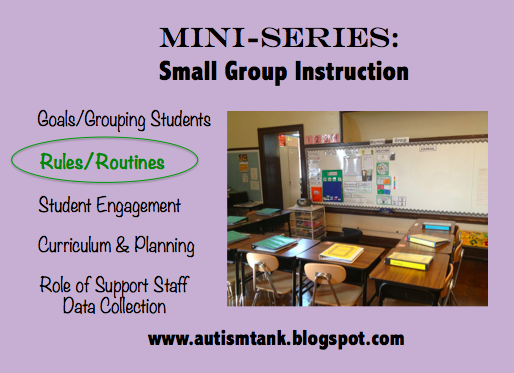
Mini Series: Small Group Instruction Rules and Routines

In my self contained (Federal Setting 3) classroom, I like to include a variety of learning opportunities for students throughout the day.  Students work independently, 1:1 or 1:2 with an adult, in small groups with 3-8 students, or together as a whole class (13 students).  When I first started teaching, I didn't dare to have any small groups regularly scheduled into my day because my students didn't seem I wasn't ready.  My students didn't have the skills to sit together without fighting or jumping up and running away from the table...and in the beginning, I didn't realize this was something I could teach them.  Small groups can be difficult to implement in a special education classroom without clear planning and prioritizing of your goals...you have students of varying abilities, students who don't get along socially, not to mention students who don't have pre-requisite functional skills for participating in a group.

Throughout this mini series, I wanted to focus on how to set up/plan for small group instruction. As you start to create your vision of what you want your small groups to look like and what your goals for your students are, I think it is important to make sure you relay this information to your paraprofessionals so they can help you in carrying out your vision whether they are supporting a small group you are leading or running one that you have set up for them.

1.  Establishing Big Picture Goals and Grouping Students
2.  Establishing Rules/Routines/Norms for the Group 
3.  Student Engagement/Teaching Techniques
4.  Curriculum and Planning
5.  Data Collection and Role of Support Staff

Monday, August 29, 2016

Mini Series: Small Group Instruction Big Picture Goals/Grouping Students

In my self contained (Federal Setting 3) classroom, I like to include a variety of learning opportunities for students throughout the day.  Students work independently, 1:1 or 1:2 with an adult, in small groups with 3-8 students, or together as a whole class (13 students).  When I first started teaching, I didn't dare to have any small groups regularly scheduled into my day because my students didn't seem I wasn't ready.  My students didn't have the skills to sit together without fighting or jumping up and running away from the table...and in the beginning, I didn't realize this was something I could teach them.  Small groups can be difficult to implement in a special education classroom without clear planning and prioritizing of your goals...you have students of varying abilities, students who don't get along socially, not to mention students who don't have pre-requisite functional skills for participating in a group.


Throughout this mini series, I wanted to focus on how to set up/plan for small group instruction. As you start to create your vision of what you want your small groups to look like and what your goals for your students are, I think it is important to make sure you relay this information to your paraprofessionals so they can help you in carrying out your vision whether they are supporting a small group you are leading or running one that you have set up for them.

1.  Establishing Big Picture Goals and Grouping Students 
2.  Establishing Rules/Routines/Norms for the Group 
3.  Student Engagement/Teaching Techniques
4.  Curriculum and Planning
5.  Data Collection and Role of Support Staff
Tuesday, August 23, 2016

All About Me...En Español!

One of my fabulous readers/customers made a request for my best selling All About Me product to be translated into Spanish for her Spanish Immersion Kindergarten classroom...and she wasn't the only one made this request.  But the coolest part, was that she made a bonus offer to translate for me!  So, here we are...my All About Me product available in Spanish...appropriately now titled Todo Sobre Mí!  One of my favorite parts (I'm a geek) of creating this was learning how to make all the accents and unique Spanish characters on my Mac (í, ñ, ¿....isn't that cool?!)

This product contains all the same interactive worksheets as my original product...the directions for the product are still in English, but all student material is in Spanish.  Pieces can be laminated and velcroed to the bottom of each page so students can move them up when answering the prompts...this makes them re-usable so students can repeat this activity daily!  I like to bind the pages together to form a book. 


 Three versions of this worksheet are also available with varying visual prompts for learners of differing ability levels.

I think this would make a great activity in any Spanish classroom (immersion or prep provider), as well as great for second language learners or as a homework activity to send home with your bilingual students!  Hope you enjoy...and please email me if there are any other products you would like to see translated for your students!


Wednesday, August 17, 2016

How to Keep/Get Parents Involved

Depending on your classroom makeup, you most likely have parents who are interested in different level of parent involvement.  I am a firm believer that students are most successful when their parents and teacher are on the same page...and this is the first thing I told parents in our beginning of the year letter.

And since this is so important to me, I wanted to share with you a couple of the ways I encourage parent involvement in my classroom. Click on links throughout the post for other posts that go more into depth on these topics.

Monday, August 15, 2016

What Should You Wear: Adapted Book Spotlight

I have been loving on Adapted books this summer.  Check out this post for some awesome resources for creating and finding pre-made adapted books.  I especially love this adapted book "What Should You Wear" because is targets so many different skills during one activity.  It works on reading (the book uses simple language and repetitive phrases), comprehension (there are pictures to aid in comprehending each page), it is hands-on (there are questions on each page for students to answer), and it targets important self help/independence skills (identifying clothes to wear in a variety of weather conditions/situations).